Ryan McDonough

Founder, Sometime Artist

CFO and co-founder @Accompany, acquired by @Cisco. Turnaround CFO @Ning, sold to Glam Media. Former seed VC. McKinsey trained. @Wharton School and @Haas School of Business.

Follow

DESIGN

No Regrets, Some Damage

A 39-year retrospective of a skateboard that was never supposed to survive this long.
DESIGN

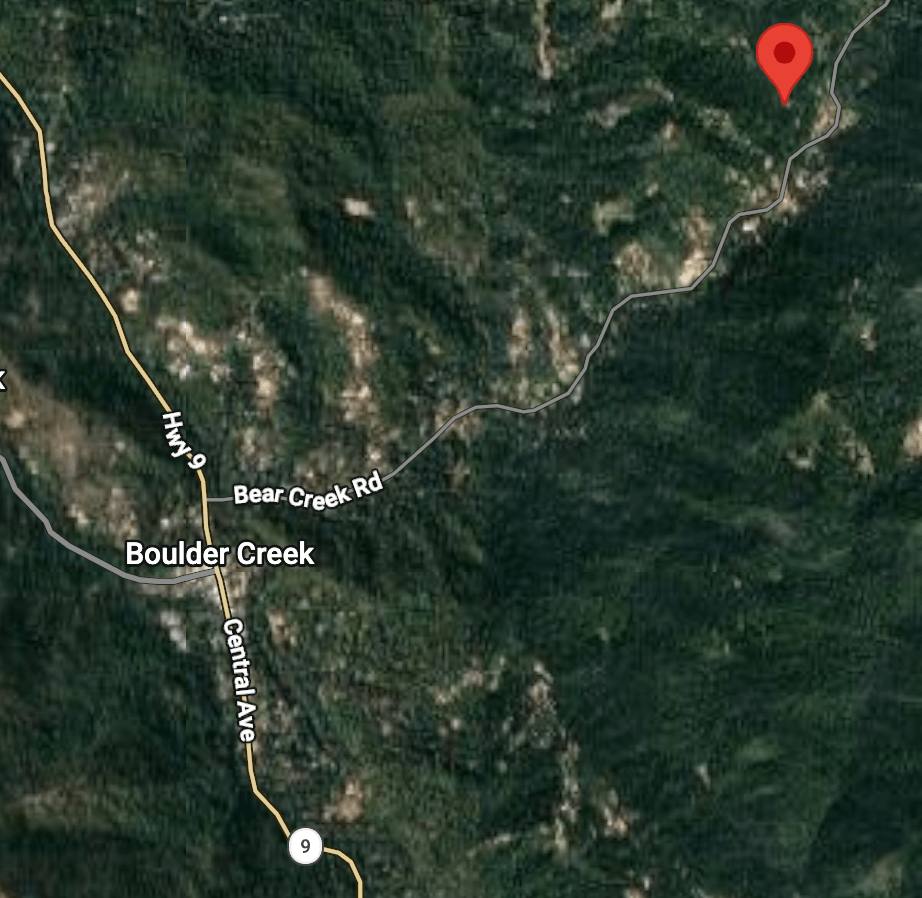
In 1987, I was twelve years old, living in Boulder Creek, California, and the proud owner of a Jeff Grosso Demon skateboard from Santa Cruz Skateboards.


It was transportation. It was freedom. It was how I got around.


Nearly four decades later, it’s apparently art.

The Original

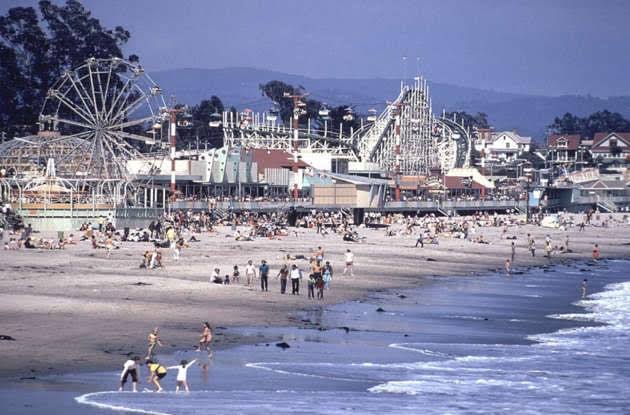
Growing up in the Santa Cruz Mountains meant that getting anywhere under your own power involved a fair amount of geography.


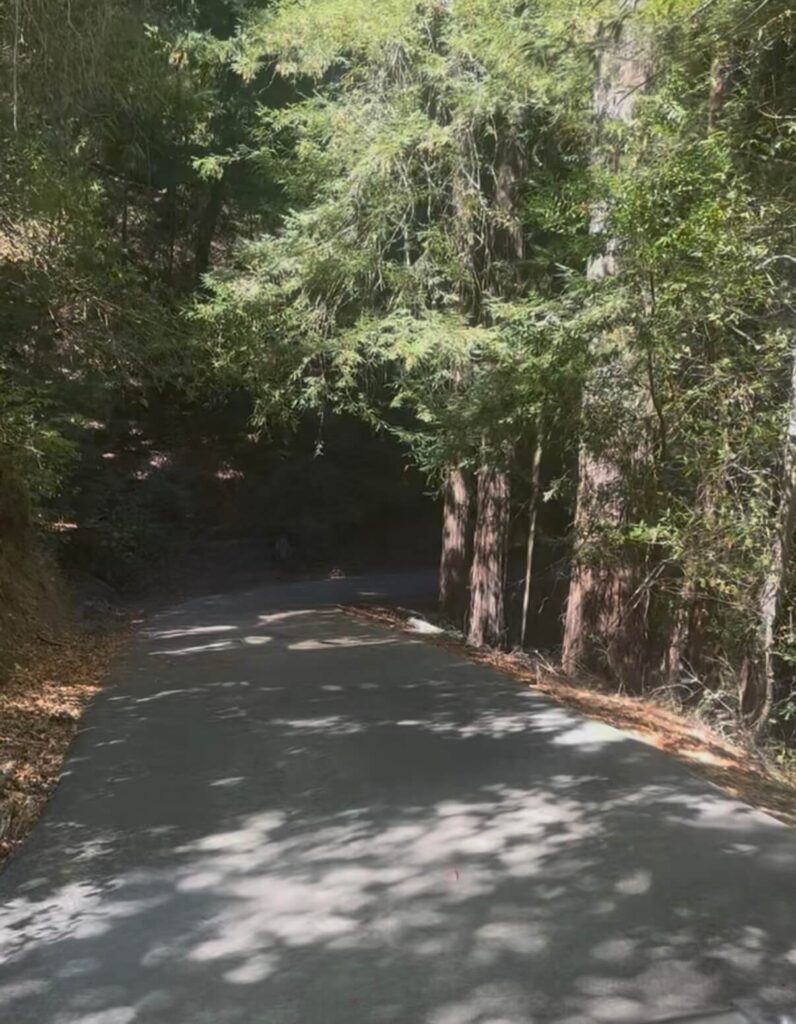
Our house sat at the top of a steep, quarter-mile paved driveway that ended at a dirt road. Beyond that lay miles of mountain roads, bus stops, and eventually Santa Cruz itself.


My skateboard was how I navigated that world.


It wasn’t a collector’s item. It wasn’t an investment. It wasn’t something I imagined preserving for posterity. It was a practical, everyday object that took me places I otherwise couldn’t easily go.


There was just one small engineering problem.


Brakes.


Skateboards, as it turns out, don’t come with them.


My solution was to drag the tail against the pavement to control my speed. This was reasonably effective at slowing me down and spectacularly effective at removing material from the skateboard.


Over time, I literally ground part of it away.


I also accumulated the usual scratches, chips, scrapes, and assorted evidence of a childhood spent using the thing rather than admiring it.


And somehow, I kept it.

The Reproduction

Fast-forward to 2026.


I found a pristine reproduction of the same Jeff Grosso Demon deck. Same iconic graphic, same basic silhouette, but without nearly forty years of asphalt-based modification.


Seeing the two together was unexpectedly wonderful.


One was exactly what the skateboard was supposed to look like.


The other was what happened when a twelve-year-old actually owned one.


The reproduction wasn’t really a replacement. It was a reference point. A way of seeing the original more clearly.


Side by side, they tell a story that neither could tell alone.

The Installation

My first instinct was to hang the two decks on the wall.


But the more I thought about it, the more I wanted to treat them as an actual gallery installation.


Not because a battered skateboard needs to be elevated into fine art, but because treating something so gloriously ordinary with complete institutional seriousness is inherently funny.


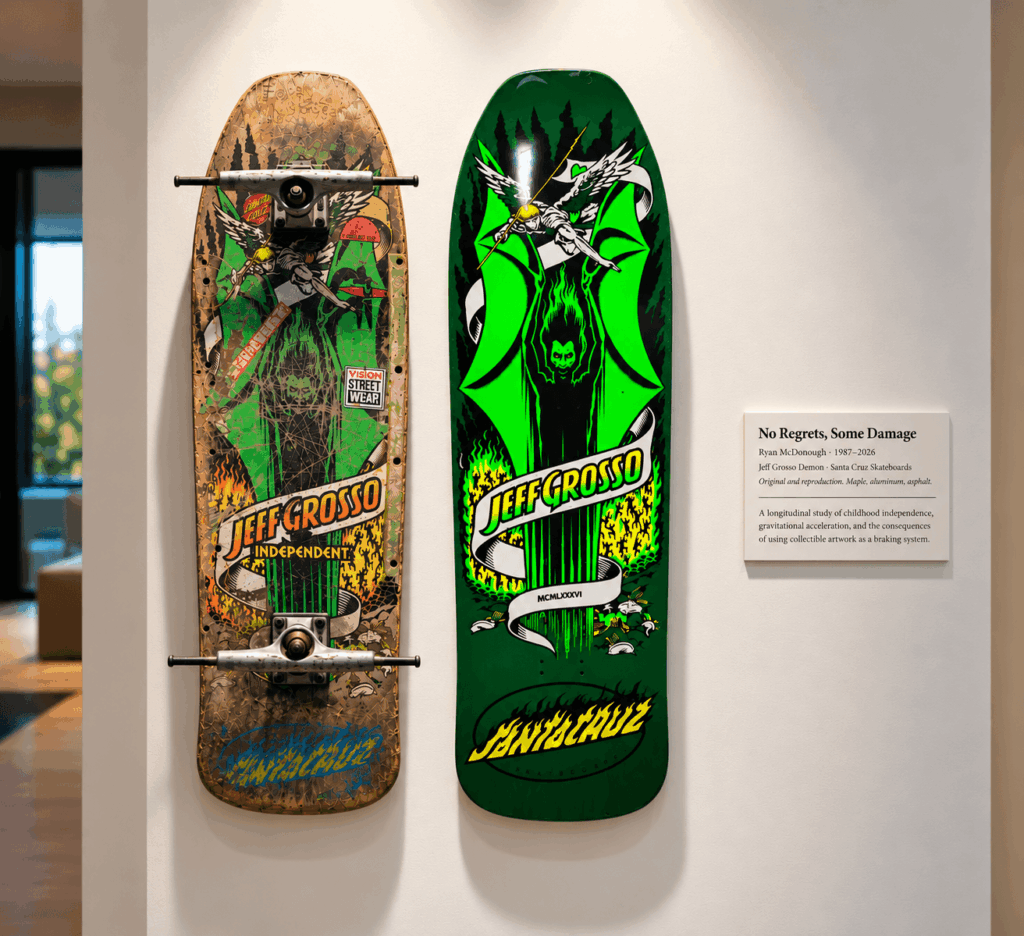
The original hangs on the left, still wearing its old trucks but without wheels. The pristine reproduction hangs beside it, unadorned.


Both float slightly off the wall on concealed mounts, with their noses aligned. The original is a little shorter now, thanks to my improvised braking system.


That difference stays.


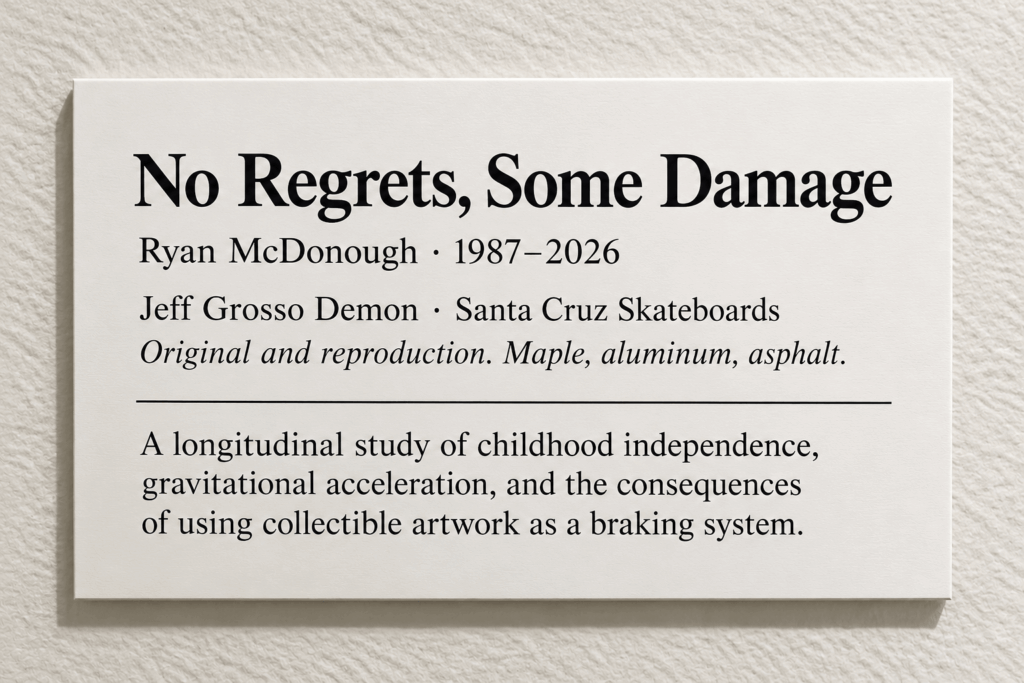
Then there’s the museum placard.

The Journey Begins

No Regrets, Some Damage

Ryan McDonough · 1987–2026

Jeff Grosso Demon · Santa Cruz Skateboards

Original and reproduction. Maple, aluminum, asphalt.


A longitudinal study of childhood independence, gravitational acceleration, and the consequences of using collectible artwork as a braking system.


The plaque is deliberately understated: a small white museum card, complete with the kind of academic description normally reserved for objects with rather more distinguished provenance.


I’m even planning to mount it magnetically, so it can be removed whenever I want the skateboards to speak for themselves.


Some days it’s a pair of skateboards.


Other days it’s an exhibition.

What Changed

There’s a temptation, when you rediscover something from childhood, to restore it.


Clean it up. Fix the damage. Make it look the way it did when you first got it.


But in this case, the damage is the point.


The missing wood isn’t a defect. It’s a record of all those trips down the driveway, all the journeys that followed, and the wonderfully questionable judgment of a kid figuring out how to get around on his own.


The pristine reproduction shows how the journey began.


The original shows what I did with it.


And at fifty, I find that distinction pretty satisfying.


I wouldn’t trade the scratched-up original for a perfect one. I wouldn’t undo the wear, even if I could.


It took thirty-nine years to make it look like that.


No regrets. Some damage.

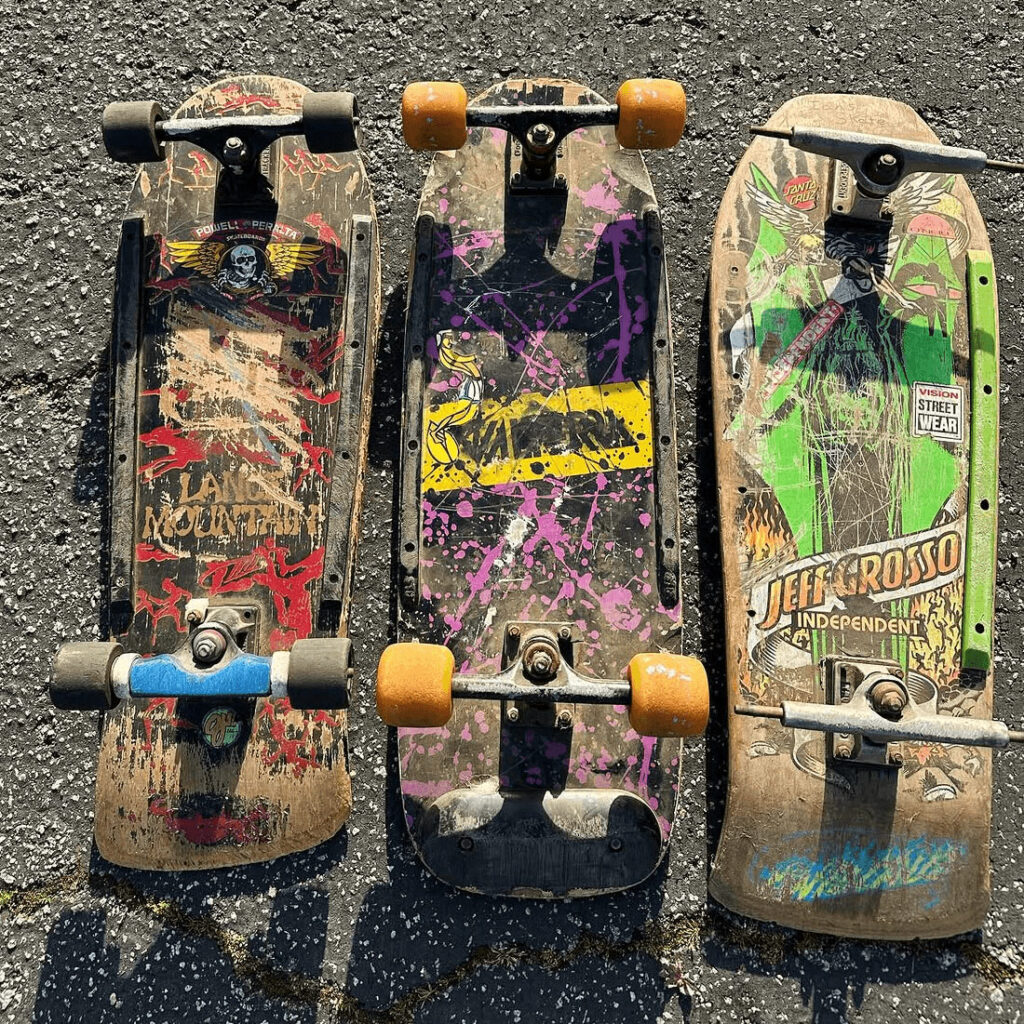
In Good Company: My Jeff Grosso with my brother’s Powell Peralta Bones Brigade Lance Mountain and Valterra board.

A Little History: The Jeff Grosso Demon

For anyone who wasn’t skateboarding in the 1980s, a little context on why this particular deck is worth revisiting.


Santa Cruz and the Golden Age of Skateboard Graphics

Santa Cruz Skateboards has been around since 1973, making it one of the oldest surviving names in skateboarding. And while the company produced some terrific boards, its influence extended well beyond the actual equipment.


A big part of that was artist Jim Phillips.


Phillips helped define the visual language of skateboarding in the 1970s and 1980s, creating wildly imaginative graphics filled with monsters, skulls, eyeballs, and other wonderfully strange imagery. His most recognizable creation is probably the Santa Cruz Screaming Hand.


By the mid-1980s, skateboard decks had become something like mobile canvases. Professional skaters had signature models, each with its own shape and artwork. The graphics weren’t merely decoration; they were a huge part of a board’s identity.


There was something wonderfully impractical about all this. Companies commissioned elaborate artwork, printed it onto beautiful maple decks, and sold them to kids whose primary objective was to scrape them against concrete.


I certainly did my part.


Jeff Grosso and His Demon

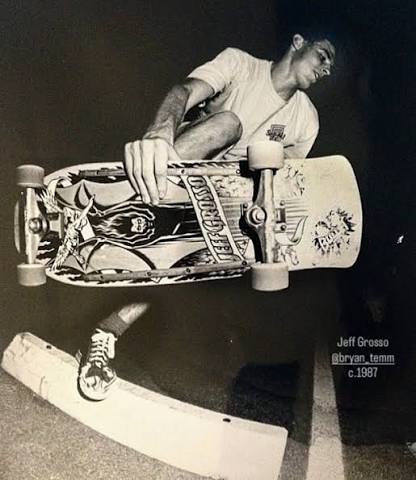
Jeff Grosso was one of the great personalities of 1980s skateboarding.


A powerful vertical skater with an irreverent streak, Grosso became known as much for his outspoken personality as his skating. He was part of a generation that helped define skateboarding as something more than a sport, with its own art, music, humor, and attitude.


In 1987, Santa Cruz released the Jeff Grosso Demon, with artwork by Jim Phillips.


Grosso wanted something dark, drawing on the classic struggle between good and evil. In later recollections, he joked that Phillips’ interpretation ended up looking a little too much like something from Disney.


Personally, I think that’s part of its charm.


The graphic is gloriously over-the-top, exactly the sort of thing that would appeal to a twelve-year-old in 1987. It also represents an era when skateboard shapes were much more individualistic than the relatively standardized popsicle decks that followed.


The graphics and shapes were part of the personality of the skateboarder whose name appeared on the board.


And while the Demon is now a collectible piece of skateboard history, I can assure you that nobody was discussing its future investment value when I was dragging mine down a driveway.


From Everyday Equipment to Collectible Art

As skateboarding evolved, many of those distinctive 1980s decks disappeared. They were ridden, broken, thrown away, or simply left in garages.


Which is what made the surviving originals interesting.


Over time, collectors began treating vintage skateboard decks as legitimate pieces of graphic art and cultural history. Original examples, particularly those in good condition, became increasingly desirable.


Santa Cruz also began revisiting classic designs from its archives, including the Demon, which returned as a modern reissue in 2015.


That’s what made this installation possible.


The reproduction lets me see the artwork and original design as they were intended, while my 1987 board provides a rather more detailed record of what actually happened.


I love that the same object can be viewed as sporting equipment, transportation, graphic art, a collectible, or a piece of personal history.


In my case, it managed to be all five.


Although I suspect Jim Phillips would have preferred that I find a different braking system.